Sintu Kumar
What Is Crypto Gas Fee? A Complete Guide
Cryptocurrency transactions may look simple from the outside, but many blockchain networks require users to pay a small amount to process and confirm transactions. This payment is commonly called a crypto gas fee. Understanding what is crypto gas fee can help users make better decisions when sending tokens, swapping assets, or interacting with decentralized applications (dApps).
In simple terms, a crypto gas fee is a transaction fee paid to a blockchain network for using its computing resources. The fee compensates validators or miners for processing transactions and maintaining network security. The exact cost can change depending on the blockchain, transaction type, and network activity.
At askcryptobonus.com, we explain important crypto concepts in simple language so beginners can better understand how cryptocurrency transactions work.
What Is Crypto Gas Fee?
So, what is crypto gas fee? A crypto gas fee is the amount a user pays to have a transaction processed on a blockchain. It is similar to paying a service fee for using a financial network.
When you send cryptocurrency, swap tokens, mint an NFT, or interact with a smart contract, the blockchain must use computing power to execute the requested action. The gas fee helps compensate the network for those resources.
The term “gas” is particularly associated with Ethereum and Ethereum-compatible networks. Gas represents the computational work required to execute an operation. More complicated transactions generally require more computational resources than simple transfers.
Why Do Crypto Gas Fees Exist?
Blockchain networks are decentralized, meaning transactions are processed by distributed participants rather than a single bank or company. These participants need an incentive to validate transactions and maintain the network.
Crypto gas fees serve several purposes:
- They compensate validators or miners.
- They help prevent network spam.
- They allocate limited blockchain resources.
- They support network security.
- They prioritize transactions when demand is high.
Without transaction fees, malicious users could potentially submit huge numbers of unnecessary transactions and overwhelm a network.
How Do Crypto Gas Fees Work?
Understanding how gas works makes the concept easier to understand. When you submit a blockchain transaction, the network estimates how much computational work is needed.
A simple cryptocurrency transfer may require relatively little computation. A smart-contract interaction, token swap, or decentralized application transaction can require significantly more.
On networks such as Ethereum, the final fee depends on factors including the amount of computational work required and the current price of gas.
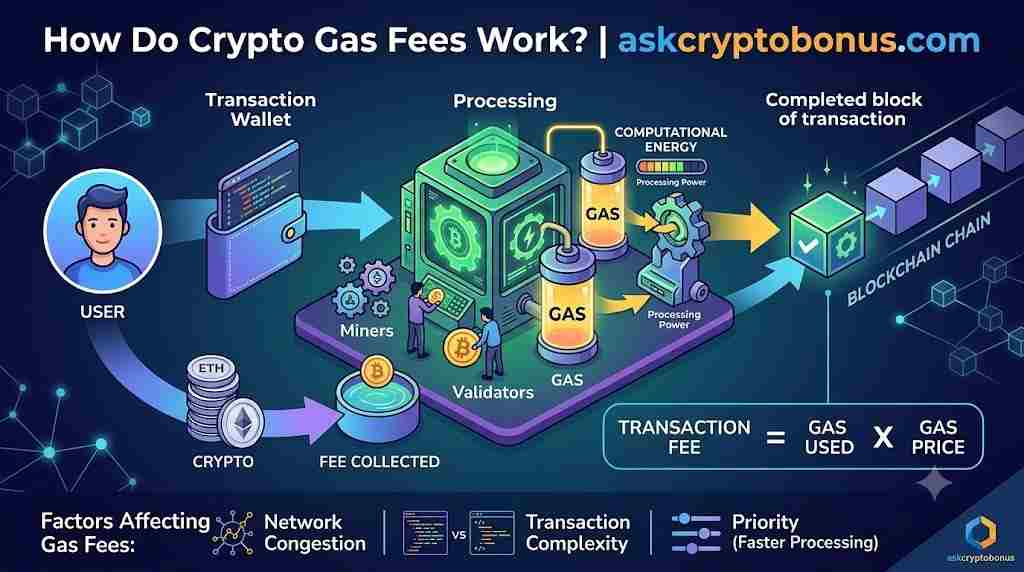
In simplified terms:
Transaction Fee = Gas Used × Gas Price
The amount you actually pay depends on the blockchain’s fee structure. Some networks use different mechanisms, so gas terminology and calculations are not identical across every cryptocurrency.
What Affects Crypto Gas Fees?
Several factors can influence a crypto gas fee.
Network Congestion
Network activity is one of the biggest factors. When many users are submitting transactions simultaneously, demand for blockchain processing increases. During busy periods, users may need to pay higher fees to get transactions processed quickly.
Transaction Complexity
Not every blockchain transaction requires the same amount of computation. Sending tokens can be relatively simple, while interacting with a smart contract may require more computational work.
Blockchain Used
Different blockchains have different fee structures. Ethereum, Polygon, BNB Chain, and other networks can have substantially different transaction costs.
Transaction Priority
Some networks allow users to influence how quickly transactions are processed by adjusting fee-related settings. Paying a higher effective fee can sometimes help a transaction receive faster processing during periods of congestion.
What Is Crypto Gas Fee on Ethereum?
Ethereum is one of the blockchain networks most closely associated with the concept of gas. Ethereum uses gas to measure the computational effort required to execute transactions and smart contracts.
For example, transferring ETH and interacting with a decentralized application do not necessarily require the same amount of computational work. A smart contract may perform multiple operations, resulting in a higher gas requirement.
Ethereum’s fee system has also evolved over time. Its current transaction-fee mechanism includes a base fee and, depending on the transaction, an optional priority fee. Because network conditions change constantly, Ethereum gas prices can move significantly within a short period.
Are Crypto Gas Fees Always Expensive?
No. A crypto gas fee is not always expensive. Fees depend on the blockchain, network conditions, transaction type, and other factors.
Some blockchains are designed to offer very low transaction costs. Layer-2 networks can also reduce costs by processing transactions more efficiently while using Ethereum for security and settlement.
However, a low-fee network may involve different trade-offs, such as differences in decentralization, security assumptions, liquidity, or ecosystem support. Users should consider the overall network rather than choosing a blockchain based only on its transaction fee.
How to Reduce Crypto Gas Fees
Users can sometimes reduce their transaction costs by choosing the right time and network.
Use Less Congested Periods
If a blockchain is experiencing heavy traffic, waiting for network demand to decrease may result in a lower fee.
Choose an Appropriate Network
When supported by the application and recipient, users may choose a lower-cost blockchain or Layer-2 network.
Check Fees Before Confirming
Most reputable wallets display an estimated transaction fee before you approve a transaction. Always review the amount carefully.
Avoid Unnecessary Transactions
Every blockchain transaction can create a cost. Combining activities where possible or avoiding unnecessary on-chain actions can help reduce expenses.
Use Layer-2 Networks
For supported applications, Layer-2 networks can offer lower transaction costs than conducting the same activity directly on Ethereum’s main network.
Crypto Gas Fees and Wallets
When users send cryptocurrency from a wallet, the wallet usually calculates or estimates the required transaction fee. The exact process depends on the blockchain and wallet provider.
It is important to understand that the gas fee is generally paid in the blockchain’s required native asset. For example, transactions on Ethereum typically require ETH for transaction fees, even when the user is transferring another token.
This means holding only the token you want to send may not be enough. You may also need some of the network’s native cryptocurrency to cover the transaction cost.
Crypto Gas Fees and Token Swaps
Token swaps can require more computational work than simple transfers because a smart contract may execute several operations.
For example, swapping one token for another through a decentralized exchange may involve smart-contract interactions. The displayed transaction cost can therefore be higher than the fee for a basic transfer.
Before confirming a swap, users should check both the transaction fee and other possible costs, such as price impact or exchange-related fees.
Are Gas Fees the Same as Exchange Fees?
No. Crypto gas fees and exchange fees are different.
A gas fee is paid for processing a blockchain transaction. An exchange fee is charged by a cryptocurrency exchange or platform for providing trading or related services.
For example, if you buy cryptocurrency on an exchange, the platform may charge a trading fee. If you later withdraw that cryptocurrency to your personal wallet, a separate blockchain transaction fee may apply.
Understanding this difference helps users avoid confusion when calculating the total cost of a crypto transaction.
Common Mistakes to Avoid
Beginners can make several mistakes when dealing with gas fees.
First, they may forget to keep enough of the blockchain’s native cryptocurrency in their wallet. Second, they may approve transactions without checking the estimated fee. Third, they may assume that every blockchain has the same fee system.
Another common mistake is sending assets on the wrong network. Always confirm that the sending and receiving networks are compatible before completing a transaction.
Users should also remember that blockchain transactions are generally irreversible. Carefully check wallet addresses, networks, amounts, and fees before confirming.
Why Understanding Gas Fees Matters
Knowing what is crypto gas fee is important for anyone who regularly uses cryptocurrency. Transaction costs can affect the profitability of trading, transferring assets, using DeFi applications, and interacting with NFTs.
A better understanding of fees allows users to compare networks, choose suitable transaction times, and avoid unexpected costs.
For beginners, the most important point is simple: gas fees are payments required by certain blockchain networks to process transactions and execute blockchain operations.
Conclusion
So, what is crypto gas fee? It is a blockchain transaction cost that compensates the network for the computational resources required to process an operation. Gas fees can vary depending on the blockchain, transaction complexity, network congestion, and fee mechanism.
Users should always check transaction fees before confirming a transaction and make sure they have enough of the network’s native cryptocurrency to pay the required cost. Learning how gas fees work can make cryptocurrency transactions easier to understand and help users manage their crypto more effectively.
For more beginner-friendly cryptocurrency guides, visit askcryptobonus.com.
FAQ
What is crypto gas fee in simple words?
A crypto gas fee is a transaction cost paid to a blockchain network for processing a transaction or executing an operation such as a smart contract.
Why do I need to pay a gas fee?
Gas fees compensate blockchain validators or miners for processing transactions and help protect the network from spam and excessive usage.
Can crypto gas fees change?
Yes. Gas fees can change based on network congestion, transaction demand, blockchain conditions, and the type of transaction.
Which cryptocurrency is used to pay gas fees?
This depends on the blockchain. Ethereum transactions generally require ETH for fees, while other networks use their own native assets.
Can I avoid crypto gas fees?
Usually, you cannot completely avoid a required blockchain transaction fee. However, you may reduce costs by using lower-fee networks, Layer-2 solutions, or transacting when network demand is lower.
Are gas fees refundable?
Generally, blockchain transaction fees are not refundable once the transaction has been processed. Even a failed smart-contract transaction may consume network resources and therefore still incur a fee.
Are gas fees the same on every blockchain?
No. Different blockchains use different fee structures, and transaction costs can vary considerably between networks.
How can I check a gas fee before sending crypto?
Most cryptocurrency wallets show an estimated transaction fee before you approve the transaction. You can also check blockchain explorers and network fee trackers for current conditions.