Sintu Kumar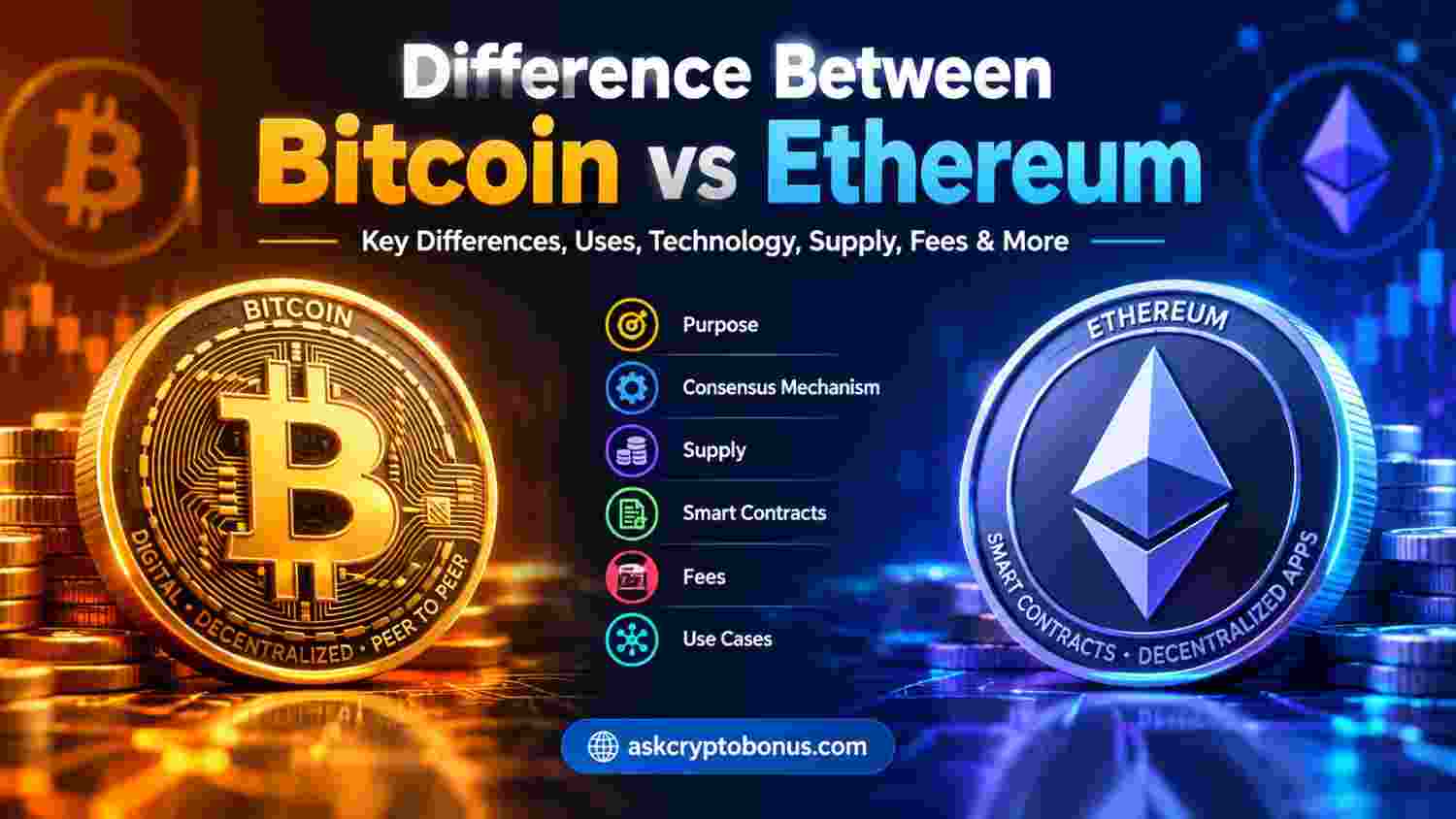
Difference Between Bitcoin vs Ethereum: A Complete Guide
Bitcoin and Ethereum are two of the most recognized names in the cryptocurrency industry. Although both use blockchain technology and support decentralized digital assets, they were created with different goals. Understanding the difference between bitcoin vs ethereum can help beginners understand how these networks work and what makes BTC and ETH different.
Bitcoin was launched in 2009 as a decentralized digital currency designed to allow peer-to-peer payments without relying on banks or other central authorities. Ethereum launched in 2015 with a broader purpose: creating a programmable blockchain that can support smart contracts and decentralized applications.
What Is Bitcoin?
Bitcoin is a decentralized blockchain network and digital currency. Its native cryptocurrency is called Bitcoin (BTC). The network allows users to send and receive value directly without requiring a traditional financial intermediary.
One important feature of Bitcoin is its limited supply. The Bitcoin protocol has a maximum supply of 21 million BTC. This scarcity is one reason Bitcoin is often described as digital gold.
Bitcoin uses a Proof-of-Work (PoW) consensus mechanism. Miners use computing power to validate transactions and add new blocks to the blockchain. This approach is designed to protect the network from attacks and maintain its decentralized nature.
Bitcoin’s primary use cases include transferring value, holding an asset for the long term, and using cryptocurrency as an alternative form of digital money.
What Is Ethereum?
Ethereum is a decentralized blockchain network designed for more than simple payments. Its native cryptocurrency is called Ether (ETH). Ethereum allows developers to create and deploy smart contracts and decentralized applications.
Smart contracts are programs stored on the blockchain that can execute according to predefined rules. They can support applications involving decentralized finance, digital assets, games, marketplaces, and many other use cases.
Ethereum uses Proof-of-Stake (PoS) rather than Bitcoin’s Proof-of-Work system. Validators stake ETH to participate in securing and validating the network.
ETH is also used to pay transaction fees and computational costs on Ethereum.
Difference Between Bitcoin vs Ethereum
The main difference between bitcoin vs ethereum is their purpose.
Bitcoin was primarily designed as decentralized digital money and a store of value. Ethereum was designed as a programmable blockchain platform where developers can build applications.
Here are some of the major differences:
| Feature | Bitcoin | Ethereum |
| Launch | 2009 | 2015 |
| Native asset | BTC | ETH |
| Main purpose | Digital money and store of value | Smart contracts and decentralized applications |
| Consensus | Proof of Work | Proof of Stake |
| Smart contracts | Limited scripting | Core functionality |
| Maximum supply | 21 million BTC | No fixed maximum supply |
| Network fees | Paid in BTC | Paid in ETH |
| Main ecosystem | Payments and Bitcoin-based applications | DeFi, NFTs, tokens, dApps and more |
These differences show why Bitcoin and Ethereum should not simply be viewed as competing cryptocurrencies. They are blockchain networks designed around different objectives.
Bitcoin vs Ethereum: Consensus Mechanism
Another important difference between bitcoin vs ethereum is how their networks are secured.
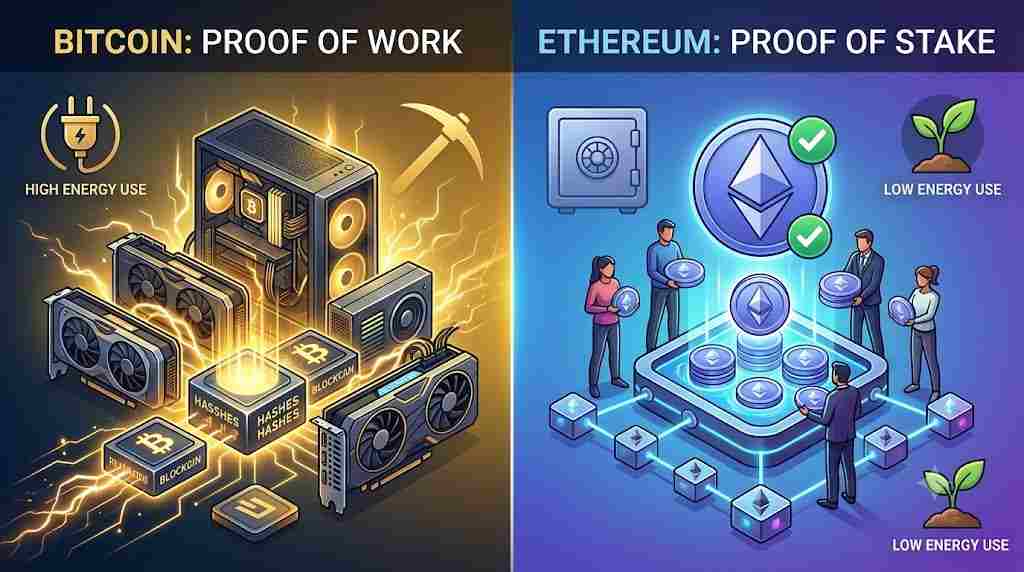
Bitcoin uses Proof of Work. In this model, miners compete to add blocks to the blockchain by performing computational work. Successful miners can receive rewards for contributing to network security.
Ethereum uses Proof of Stake. Instead of miners competing through computing power, validators participate by staking ETH. Validators help propose and confirm blocks and can face penalties for certain dishonest behavior.
The move to Proof of Stake significantly changed Ethereum’s energy requirements compared with its previous Proof-of-Work design.
Difference in Supply
Bitcoin has a clearly defined maximum supply of 21 million BTC. New bitcoin enters circulation according to predetermined issuance rules, with block rewards periodically reduced through halvings.
Ethereum does not have the same fixed maximum supply. ETH issuance follows Ethereum’s protocol rules and is affected by factors such as staking. Ethereum also burns a portion of transaction fees under its fee mechanism, meaning its supply can change depending on network activity.
This is an important difference between bitcoin vs ethereum for people comparing their monetary designs.
Smart Contracts and Applications
Bitcoin’s scripting capabilities are intentionally limited compared with Ethereum. Its design focuses heavily on secure and reliable value transfer.
Ethereum was created with programmability as a central feature. Developers can use smart contracts to build decentralized applications without needing a traditional centralized server or intermediary.
Ethereum’s ecosystem supports applications such as decentralized exchanges, lending protocols, stablecoins, digital collectibles and blockchain-based games.
This makes Ethereum particularly important for people interested in blockchain applications rather than cryptocurrency payments alone.
Bitcoin vs Ethereum: Which Is Faster?
Transaction processing and finality work differently across the two networks. Bitcoin generally produces blocks at a slower rate, while Ethereum’s proof-of-stake network reaches finality through its validator system.
However, saying that one network is simply “faster” can be misleading because actual transaction experience also depends on fees, network activity, scaling solutions and whether users are interacting with a Layer 2 or another supporting network.
Therefore, the difference between bitcoin vs ethereum should be evaluated based on the use case rather than speed alone.
Bitcoin vs Ethereum for Investment
Bitcoin and Ethereum are both widely followed crypto assets, but they have different investment narratives.
Bitcoin is often viewed as a scarce digital asset and long-term store of value. Its 21-million supply limit is a major part of its monetary design.
Ethereum has a different value proposition because ETH is closely connected to the Ethereum network. ETH is required for transaction fees and is also involved in securing the network through staking.
Neither asset is guaranteed to increase in value. Cryptocurrency prices can be highly volatile, so users should research independently and consider their risk tolerance before making financial decisions.
For educational crypto guides, askcryptobonus.com can also help readers learn more about cryptocurrency concepts, blockchain technology, wallets, transactions and digital assets.
Which Is Better: Bitcoin or Ethereum?
There is no universal answer to which cryptocurrency is better. The right choice depends on what a person wants to use blockchain technology for.
Bitcoin may be more suitable for someone primarily interested in decentralized digital money, scarcity and long-term value storage.
Ethereum may be more suitable for someone interested in smart contracts, decentralized applications, tokens and programmable blockchain technology.
Instead of asking which one is universally better, it is more useful to understand the difference between bitcoin vs ethereum and decide which network fits a particular goal.
Conclusion
The difference between bitcoin vs ethereum comes mainly down to their purpose and technical design. Bitcoin focuses on decentralized money, security and scarcity, while Ethereum focuses on programmability, smart contracts and decentralized applications.
Bitcoin uses Proof of Work and has a maximum supply of 21 million BTC. Ethereum uses Proof of Stake and has a more flexible monetary policy. Ethereum also provides a broader environment for developers to create blockchain-based applications.
Both networks have played important roles in the development of cryptocurrency. Understanding their differences can help beginners make better-informed decisions when learning about the crypto ecosystem.
FAQ: Difference Between Bitcoin vs Ethereum
What is the main difference between Bitcoin and Ethereum?
The main difference between bitcoin vs ethereum is their purpose. Bitcoin primarily focuses on decentralized digital money and store of value, while Ethereum is a programmable blockchain designed to support smart contracts and decentralized applications.
Is Bitcoin better than Ethereum?
Neither is universally better. Bitcoin and Ethereum were designed for different purposes. Bitcoin emphasizes monetary use and scarcity, while Ethereum focuses on programmable applications and digital assets.
Is Ethereum more useful than Bitcoin?
It depends on the use case. Ethereum supports smart contracts and decentralized applications, while Bitcoin is primarily focused on decentralized value transfer and long-term monetary use.
Can Bitcoin and Ethereum be used together?
Yes. Bitcoin and Ethereum are separate blockchain networks, but users can exchange BTC and ETH or use representations of Bitcoin within Ethereum-based applications.
Is ETH the same as Ethereum?
No. Ethereum is the blockchain network, while Ether (ETH) is its native cryptocurrency. ETH is used to pay transaction fees and plays a role in securing the Ethereum network.
Should beginners learn Bitcoin or Ethereum first?
Both are useful to learn. Bitcoin provides a foundation for understanding decentralized digital money, while Ethereum helps explain smart contracts and decentralized applications.