
 Ranjeet
Which Crypto Has High Volatility? A Complete Guide
Cryptocurrency prices can change rapidly within minutes, hours, or days. While some digital assets experience relatively small price movements, others can rise or fall dramatically in a short period. Understanding which crypto has high volatility can help readers learn about market behavior, identify potential risks, and make more informed financial decisions.
At askcryptobonus.com, our goal is to explain cryptocurrency concepts in simple language so readers can understand how digital assets work. This guide explores highly volatile cryptocurrencies, the factors that influence their prices, and the risks associated with trading them.
What Is Crypto Volatility?
Crypto volatility refers to how frequently and significantly a cryptocurrency’s price moves over a specific period. A coin that experiences large price changes is considered more volatile than one with relatively stable prices.
For example, imagine a cryptocurrency trading at $100. If its price increases to $120 and later falls to $85, it has experienced substantial price fluctuations.
Volatility does not automatically mean a cryptocurrency is losing value. It can move sharply in either direction. However, larger price swings can increase the risk of financial losses.
According to educational resources from Coinbase, cryptocurrencies with lower trading volumes and smaller markets often experience greater volatility than assets with deeper liquidity.
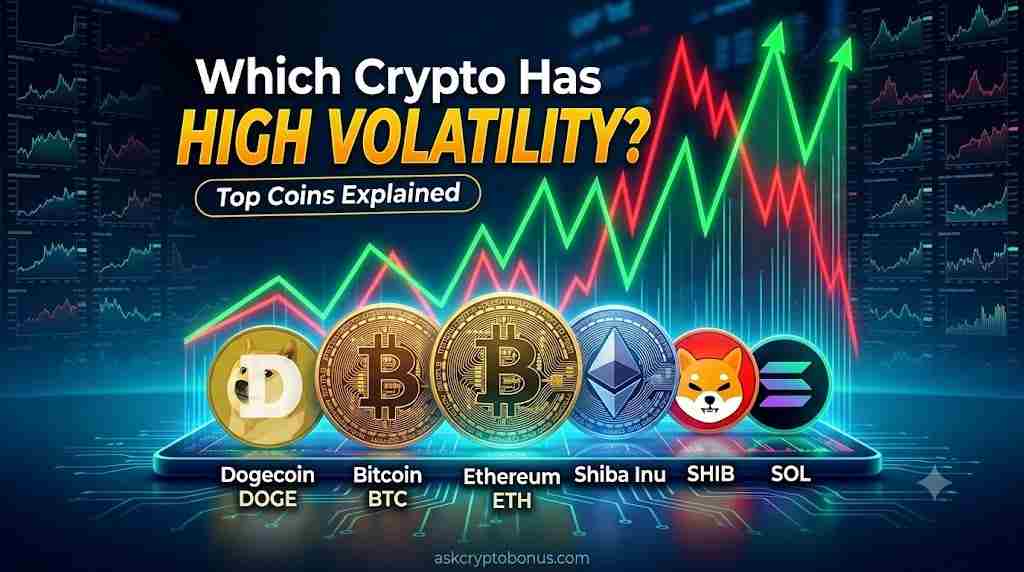
Which Crypto Has High Volatility?
There is no single cryptocurrency that is always the most volatile. Rankings change depending on market conditions, trading volume, news, and the period being measured.
The following cryptocurrencies and token categories can experience significant price movements.
- Dogecoin (DOGE)
Dogecoin is a popular meme-based cryptocurrency known for its active online community and sensitivity to market sentiment.
Its price can react strongly to social media discussions, public endorsements, broader cryptocurrency trends, and changes in speculative demand. These influences can produce rapid upward or downward movements.
Dogecoin is an example of how community interest can affect a digital asset’s price, even when its market behavior does not closely follow traditional financial fundamentals.
- Shiba Inu (SHIB)
Shiba Inu is another meme-inspired cryptocurrency that can experience substantial price fluctuations.
Its volatility may be influenced by social media trends, token supply dynamics, exchange activity, and changes in investor enthusiasm. Smaller individual token prices do not necessarily make an asset cheaper in valuation terms.
Investors should examine market capitalization, circulating supply, liquidity, and the potential impact of large trades rather than judging a cryptocurrency by its unit price alone.
- Solana (SOL)
Solana is a blockchain network designed to support decentralized applications, digital assets, and other on-chain activities.
SOL can experience volatility because of changing market sentiment, network-related developments, competition between blockchain platforms, and demand for decentralized finance applications.
Although Solana is an established crypto asset, its price can still move significantly during periods of market uncertainty or increased speculative activity.
- Ethereum (ETH)
Ethereum is a major blockchain platform used for smart contracts, decentralized applications, and token issuance.
ETH is generally more established than many smaller cryptocurrencies, but it can still experience substantial price changes. Market-wide sell-offs, regulatory developments, network upgrades, and shifts in demand can influence its price.
Ethereum demonstrates that even widely traded cryptocurrencies are not immune to volatility or significant losses.
- Smaller Altcoins and Emerging Tokens
Smaller altcoins and newly launched tokens can be particularly volatile because they may have limited trading history, concentrated ownership, and relatively low liquidity.
A modest purchase or sale can sometimes produce a large price movement when there are few buyers and sellers. Promotional campaigns and speculative interest may also contribute to sudden price spikes.
However, a rapid price increase does not guarantee continued growth. Some tokens lose most of their value after initial excitement fades, and certain projects may never recover.
- AI-Related and DeFi Tokens
Artificial intelligence (AI) and decentralized finance (DeFi) tokens can experience sharp price movements when new technologies, partnerships, product launches, or market narratives attract attention.
These assets may react strongly to changes in expectations about future adoption. If interest declines or a project fails to meet expectations, prices can fall just as quickly.
The actual volatility of each token depends on its liquidity, tokenomics, market participation, and current conditions.
Why Are Some Cryptocurrencies More Volatile Than Others?
Several factors explain why one cryptocurrency may experience larger price movements than another.
Low Market Liquidity
Liquidity refers to how easily an asset can be bought or sold without substantially changing its price. When a cryptocurrency has limited liquidity, even a relatively small trade can cause a noticeable price movement.
Market Sentiment and Social Media
Cryptocurrency markets can react quickly to online discussions, influencer commentary, rumors, and breaking news. Positive sentiment may increase buying pressure, while negative sentiment can trigger rapid selling.
Regulatory Developments
Government announcements, exchange restrictions, legal decisions, and changes in cryptocurrency regulations can influence demand. Uncertainty surrounding a project’s legal status may create additional price fluctuations.
Leverage and Liquidations
Some traders borrow funds or use leveraged derivatives to increase their market exposure. When prices move against these positions, exchanges may liquidate them, adding more buying or selling pressure to the market.
Leverage can amplify losses and make an already volatile market more unpredictable.
Token Supply and Large Holders
Token unlocks, changes in circulating supply, and transactions by large holders can affect market prices. Assets with concentrated ownership may be especially sensitive to large transactions.
Explore Crypto Markets with Confidence
Want to learn more about which crypto has high volatility and how digital asset markets work? Before making any investment decisions, compare cryptocurrency prices, historical volatility, trading volume, and potential risks.
Explore crypto market data and educational resources to better understand Bitcoin, Ethereum, Dogecoin, Shiba Inu, and other digital assets.
Ready to explore the crypto market?
👉 Explore Cryptocurrency Markets
Visit CoinGecko to research cryptocurrency prices, market capitalization, trading volume, and historical market data.
At askcryptobonus.com, we encourage readers to research every cryptocurrency carefully and understand the risks before investing.
Affiliate Disclosure
This article may contain affiliate links. If you use an affiliate link, askcryptobonus.com may receive a commission at no additional cost to you. Affiliate relationships do not determine our educational content or recommendations. Cryptocurrency investments involve substantial financial risk, and you could lose your entire investment. Always conduct independent research before making financial decisions.
How Can You Measure Crypto Volatility?
To understand which crypto has high volatility, compare multiple measurements rather than relying on a single day’s price change.
- Historical volatility: Measures how much an asset’s returns have fluctuated over a selected period.
- Average true range (ATR): Estimates the typical range of price movement over a specified period.
- Trading volume: Helps indicate how actively an asset is traded, although volume alone does not establish liquidity.
- Market capitalization: Provides context about an asset’s overall market value.
- Maximum drawdown: Measures the largest decline from a previous peak to a subsequent low during a chosen period.
Compare assets over the same timeframe, such as 30 days, and use consistent data sources. A token with a large one-day gain is not necessarily the most volatile over an entire month.
You can review volatility rankings and market data through resources such as CoinGecko and TradingView, while remembering that rankings may differ by methodology.
How to Manage High Crypto Volatility
Understanding volatility is useful, but it does not eliminate investment risk. Consider these precautions before making financial decisions.
- Research each project: Review its purpose, development activity, tokenomics, liquidity, and publicly available documentation.
- Avoid investing money you cannot afford to lose: Cryptocurrency prices can decline substantially, and recovery is never guaranteed.
- Be cautious with leverage: Leveraged trading can lead to rapid losses and forced liquidations.
- Diversify thoughtfully: Holding several assets does not guarantee protection because cryptocurrencies can fall together during market-wide downturns.
- Use reliable market data: Compare price history, trading volume, liquidity, and volatility over consistent periods.
- Avoid emotional decisions: Sudden price increases can encourage fear of missing out, while sharp declines can trigger panic selling.
At askcryptobonus.com, we encourage readers to understand the risks of digital assets before making financial decisions. No volatility ranking can reliably predict which cryptocurrency will rise next.
Conclusion
So, which crypto has high volatility? Meme coins such as Dogecoin and Shiba Inu, smaller altcoins, and emerging AI or DeFi tokens can experience significant price swings. Solana and Ethereum can also be volatile, although their liquidity and market structures differ from those of smaller projects.
The most volatile cryptocurrency changes over time. To evaluate volatility properly, compare historical price movements, liquidity, trading volume, and market conditions over the same period.
For more educational cryptocurrency guides, visit askcryptobonus.com and continue learning about digital assets, market risks, and blockchain technology.
Frequently Asked Questions (FAQs)
- Which crypto has high volatility?
Meme coins, smaller altcoins, and some emerging AI or DeFi tokens can experience high volatility. The most volatile asset depends on the period measured and current market conditions.
- Are meme coins more volatile than Bitcoin?
Meme coins can be more volatile than Bitcoin because they may have less liquidity and depend more heavily on speculative interest. However, volatility varies by coin and timeframe.
- Why do small cryptocurrencies move so quickly?
Smaller cryptocurrencies may have fewer buyers and sellers, concentrated token ownership, and limited market depth. These conditions can magnify the effect of individual trades and sudden changes in demand.
- Can high crypto volatility create losses?
Yes. High volatility can produce rapid price declines as well as gains. Investors can lose some or all of the money they put into a cryptocurrency.
- How can I find the most volatile cryptocurrencies?
Compare historical volatility, price ranges, trading volume, and liquidity using reliable market-data platforms. Make sure the assets are evaluated over the same timeframe.
- Is Bitcoin a highly volatile cryptocurrency?
Bitcoin has historically experienced significant price swings compared with many traditional investments. It may be less volatile than certain smaller cryptocurrencies, but it can still experience substantial declines.
- Are stablecoins volatile?
Stablecoins are designed to maintain a relatively stable value against a reference asset, often the US dollar. However, they can lose their peg, and their stability is not guaranteed.
- Should beginners trade highly volatile cryptocurrencies?
Beginners should understand the risks before trading highly volatile assets. Learning about liquidity, market behavior, and risk management is important, and no investment outcome is guaranteed.
Disclaimer: This article is for educational purposes only and does not constitute financial or investment advice. Cryptocurrency investments involve substantial risk, including the possible loss of your entire investment.


 Sintu Kumar



