
 Ranjeet
What Is Bitcoin? A Complete Beginner’s Guide
Bitcoin is one of the most well-known digital currencies in the world. Since its launch, it has changed the way many people think about money, digital payments, and financial technology. But what is bitcoin, and how does it actually work? In simple terms, Bitcoin is a decentralized digital currency that allows people to send and receive value over the internet without relying on a traditional bank to process every transaction.
Bitcoin operates through a technology called blockchain. This technology records transactions on a distributed network of computers, helping participants verify and maintain a shared record of transactions.
What Is Bitcoin and How Does It Work?
If you are wondering what is bitcoin, think of it as digital money that operates through a decentralized network. Unlike traditional currencies issued by governments and central banks, Bitcoin is not controlled by one central organization.
Bitcoin transactions are processed and recorded on the Bitcoin blockchain. The blockchain is a public digital ledger that keeps track of transactions. Network participants use specialized software and cryptographic methods to verify transactions and maintain the network.
When someone sends Bitcoin to another person, the transaction is broadcast to the network. Miners verify transactions and group them into blocks. Once a block is accepted by the network, it becomes part of the blockchain.
This decentralized structure is one of the main features that distinguishes Bitcoin from conventional payment systems.
Who Created Bitcoin?
Bitcoin was introduced in 2008 through a whitepaper published under the name Satoshi Nakamoto. In 2009, the Bitcoin network became operational.
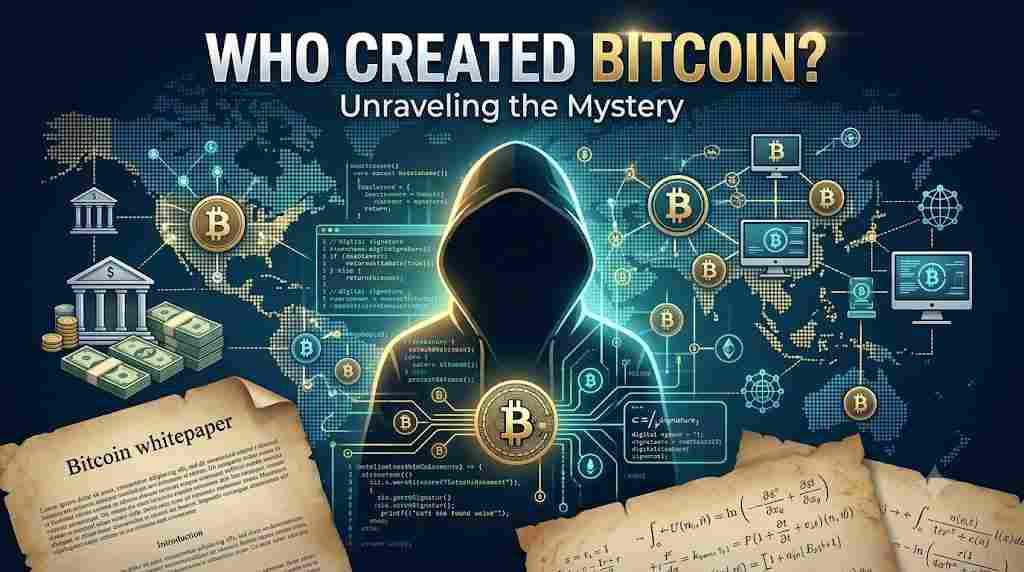
The identity of Satoshi Nakamoto remains unknown. Bitcoin was designed as an open-source project, meaning its underlying software can be examined and developed by a global community.
Understanding what is bitcoin also requires understanding its original purpose. Bitcoin was designed to enable peer-to-peer electronic transactions without requiring a trusted central financial intermediary for every payment.
How Bitcoin Transactions Work
Bitcoin transactions use digital addresses and cryptographic signatures. A person can use a Bitcoin wallet to generate an address for receiving funds and authorize transactions when sending Bitcoin.
A Bitcoin wallet does not technically store coins like a physical wallet stores cash. Instead, it provides tools for managing the cryptographic keys that allow users to control Bitcoin associated with their addresses.
Transactions are recorded on the blockchain. Because the blockchain is distributed across many computers, changing historical transaction records is designed to be difficult.
For anyone researching what is bitcoin, understanding wallets, addresses, and private keys is important because losing control of a private key can result in losing access to the associated Bitcoin.
What Is Bitcoin Mining?
Bitcoin mining is the process used by the Bitcoin network to add new blocks of transactions to the blockchain. Miners use computing equipment to compete in solving a computational challenge.
The Bitcoin network uses a consensus mechanism known as proof of work. Successful miners can receive rewards according to the network’s rules, including newly issued Bitcoin and transaction fees.
Bitcoin has a maximum supply of 21 million coins. This limited supply is one of the characteristics frequently discussed when people study what is bitcoin and how its monetary design differs from government-issued currencies.
Mining requires significant computing resources and electricity, which has led to extensive discussion about Bitcoin’s environmental impact and energy use.
What Makes Bitcoin Different?
One important feature of Bitcoin is decentralization. There is no single company or government that operates the Bitcoin network as a conventional financial institution.
Another feature is transparency. Bitcoin blockchain transactions can generally be viewed publicly, although the identities behind Bitcoin addresses are not automatically displayed on the blockchain.
Bitcoin is also divisible. One Bitcoin can be divided into smaller units called satoshis. This makes it possible to transact with fractions of a Bitcoin rather than requiring someone to own one complete coin.
These characteristics help explain what is bitcoin and why it has become an important subject within the broader cryptocurrency industry.
Benefits and Risks of Bitcoin
Bitcoin offers several characteristics that attract users. It can be transferred electronically across borders, operates on a decentralized network, and does not require a traditional bank account for direct Bitcoin-to-Bitcoin transactions.
However, Bitcoin also involves risks. Its market price can change significantly, and users are responsible for securing their wallets and private keys. Transactions generally cannot simply be reversed like a traditional card payment.
There are also regulatory, tax, security, and technological considerations that vary between countries.
Therefore, learning what is bitcoin should include understanding both its potential advantages and its risks rather than focusing only on its price or investment potential.
Bitcoin Wallets
A Bitcoin wallet is software or hardware that helps users manage their Bitcoin keys and interact with the network. Wallets can come in several forms, including mobile wallets, desktop wallets, hardware wallets, and other storage solutions.
Security is particularly important. Users should protect private keys, use reputable wallet software, and be cautious about phishing attempts and scams.
For additional cryptocurrency education, readers can also explore resources available through askcryptobonus.com to learn more about crypto concepts, wallets, and digital assets.
Is Bitcoin Legal?
Bitcoin’s legal and regulatory status differs from one country to another. Some countries permit cryptocurrency activities under specific regulations, while others have introduced restrictions.
Before buying, selling, or using Bitcoin, users should check the rules that apply in their own country. Tax treatment can also vary depending on local laws and the type of transaction.
What Is Bitcoin Used For?
Bitcoin can be used for several purposes depending on the user and jurisdiction. Some people use it for digital payments, while others hold it as a digital asset. Businesses may also accept Bitcoin where permitted.
Its use cases continue to develop alongside the broader cryptocurrency and blockchain ecosystem.
Conclusion
So, what is bitcoin? Bitcoin is a decentralized digital currency that operates through a blockchain network. It enables people to transfer value electronically without relying on a central authority to maintain the Bitcoin ledger.
Bitcoin’s decentralized design, limited supply, blockchain technology, and global accessibility have made it one of the most recognized cryptocurrencies. At the same time, users should understand price volatility, security responsibilities, regulations, and other risks before using it.
Whether you are completely new to cryptocurrency or simply want to understand the basics, learning how Bitcoin works is a useful starting point for exploring the wider digital-asset ecosystem. For more educational cryptocurrency information, you can also visit askcryptobonus.com.
Frequently Asked Questions
- What is Bitcoin in simple words?
Bitcoin is a decentralized digital currency that allows people to transfer value electronically using a blockchain network rather than relying on a central bank for every transaction.
- Who created Bitcoin?
Bitcoin was introduced by an individual or group using the pseudonym Satoshi Nakamoto. The true identity of Satoshi Nakamoto has not been publicly established.
- How does Bitcoin work?
Bitcoin uses a decentralized blockchain to record transactions. Network participants verify transactions, and miners use proof of work to help secure the network and add new blocks.
- Is Bitcoin real money?
Bitcoin is a digital asset and cryptocurrency. Whether it is legally recognized as money or permitted for particular uses depends on the laws and regulations of the relevant country.
- How many Bitcoins can exist?
Bitcoin’s protocol sets a maximum supply of 21 million Bitcoin.
- What is a Bitcoin wallet?
A Bitcoin wallet is a software or hardware tool used to manage cryptographic keys and interact with the Bitcoin network.
- Is Bitcoin safe?
Bitcoin’s underlying network uses cryptographic and decentralized mechanisms, but using Bitcoin still involves risks. Users need to protect their private keys and watch for scams, phishing, fraud, and other security threats.
- Where can I learn more about Bitcoin?
You can explore cryptocurrency educational content on askcryptobonus.com to learn more about Bitcoin, blockchain technology, wallets, and other digital assets.


 Sintu Kumar



