Sintu Kumar
How to Research a Crypto Project?: A Complete Guide
The cryptocurrency market offers many opportunities, but not every crypto project is reliable or worth researching. Some projects introduce useful technology and solve real-world problems, while others rely on hype, unrealistic promises, or misleading marketing. Learning how to research a crypto project can help beginners understand the risks before making financial decisions.
A proper crypto investigation involves examining the project’s purpose, development team, whitepaper, tokenomics, security, community, and market activity. Instead of relying on social media trends or influencer recommendations, investors should look for verifiable information.
At askcryptobonus.com, our goal is to help readers understand cryptocurrency concepts and develop better research habits. This guide explains how to evaluate a crypto project step by step.
- Understand the Purpose of the Crypto Project
The first step in learning how to research a crypto project is understanding what it actually does.
Every legitimate project should have a clear purpose. It might provide blockchain infrastructure, decentralized finance services, payment solutions, gaming applications, or digital asset management tools.
Ask yourself these questions:
- What problem does the project solve?
- Who benefits from its technology?
- Is blockchain necessary for its purpose?
- Does the project offer a useful product or service?
- Is the solution different from existing alternatives?
A project that clearly explains its purpose is easier to evaluate than one that focuses entirely on token prices or future profits.
Research tip: Visit the official website and explore the product, documentation, and available demonstrations. Check whether the project has a working product or only a roadmap.
- Read the Whitepaper and Official Documentation
A whitepaper explains a crypto project’s objectives, technology, token design, and development plans. It is one of the most important resources when researching a cryptocurrency.
When investigating how to research a crypto project, do not read the whitepaper only to understand its promises. Look for technical details and evidence supporting its claims.
Pay attention to:
- Project objectives: What is the project trying to achieve?
- Technology: How does the system work?
- Use cases: Why would people use it?
- Roadmap: Are milestones specific and realistic?
- Risks: Does the documentation acknowledge limitations?
- Token utility: What function does the token serve?
Be cautious if documentation contains vague explanations, copied content, contradictory claims, or guaranteed profit promises.
Compare the whitepaper with the project’s current product and development updates. A detailed document is useful, but it does not independently prove that a project is legitimate.
- Check the Founders and Development Team
The people behind a crypto project can provide important clues about its credibility.
Look for information about the founders, developers, advisers, and organization responsible for the project. Review professional profiles, previous projects, technical contributions, and relevant experience.
Useful checks include:
- Are the founders’ identities publicly verifiable?
- Do team members have relevant experience?
- Have they contributed to other credible projects?
- Is the development team active?
- Are partnerships confirmed by the organizations involved?
An anonymous team is not automatically fraudulent, because some legitimate crypto projects prioritize pseudonymity. However, limited transparency can make accountability more difficult.
When learning how to research a crypto project, remember that professional-looking profiles and impressive biographies can be fabricated. Verify important claims through independent sources rather than relying exclusively on the project’s website.
- Analyze Tokenomics and Token Distribution
Tokenomics refers to the economic design of a cryptocurrency, including its supply, distribution, utility, and issuance schedule.
Understanding tokenomics helps you evaluate whether a token’s structure could create risks for holders.
Review these factors:
Total and circulating supply: Total supply represents the maximum or intended number of tokens, depending on the design. Circulating supply refers to tokens currently available in the market.
Token allocation: Check how much is allocated to founders, investors, the community, and ecosystem development.
Vesting schedules: Determine when team and investor tokens become available. Large unlocks can increase potential selling pressure.
Token utility: Find out whether the token is needed for transactions, governance, staking, or another practical function.
Inflation and burns: Understand how new tokens enter circulation and whether tokens can be permanently removed.
For example, a project may have a relatively small circulating supply but a much larger future supply. Upcoming token unlocks could affect market dynamics.
Tokenomics cannot predict future prices, but it can help reveal economic weaknesses and concentration risks.
- Review Blockchain Activity and On-Chain Data
On-chain analysis helps researchers examine publicly recorded blockchain activity.
Depending on the network, explorers and analytics platforms can provide information about transactions, wallet activity, token transfers, and contract interactions.
Check the following:
- Is the token contract address correct?
- Are transactions occurring consistently?
- Are there signs of genuine product usage?
- Is token ownership concentrated among a few wallets?
- Are large wallets moving significant amounts of tokens?
- Does reported activity match independently observable data?
For Ethereum-based assets, tools such as Etherscan can help you inspect transactions and smart contracts. Other blockchains have their own explorers.
However, transaction counts and wallet numbers can be misleading. Bots, automated transactions, and multiple wallets controlled by one person can inflate activity. On-chain data should be interpreted alongside other evidence.
- Evaluate Security and Smart Contract Audits
Security is essential when researching projects involving smart contracts, decentralized exchanges, lending protocols, or staking systems.
Look for independent security audits from identifiable firms. Read the report rather than simply trusting an “audited” badge on the website.
Consider these questions:
- Who performed the audit?
- Which version of the contract was reviewed?
- Were serious vulnerabilities identified?
- Have reported issues been fixed?
- Is the contract upgradeable?
- Are privileged permissions controlled by a single wallet?
- Does the project have a responsible vulnerability disclosure process?
An audit can reduce uncertainty, but it does not guarantee safety. New vulnerabilities, configuration mistakes, compromised administrator keys, and unaudited updates can still create risks.
Never connect your wallet or approve a transaction simply because a website claims its contracts are secure.
- Examine the Community and Partnerships
A strong community can support adoption, but follower counts alone do not prove that a crypto project is successful.
Review the project’s official social accounts, discussion forums, developer channels, and community updates. Look for meaningful questions, useful answers, and evidence of real product usage.
Be careful if discussions contain only price predictions, repeated promotional messages, or promises of guaranteed returns.
You should also verify partnerships independently. If a project claims to work with a major company, look for confirmation on that company’s official website or verified channels.
When considering how to research a crypto project, distinguish between a confirmed partnership, a simple integration, and an unverified marketing claim.
- Study Market Data and Liquidity
Market data can help you understand a token’s trading environment.
Review its market capitalization, trading volume, exchange listings, liquidity, and price history. Market capitalization is generally calculated by multiplying the token price by its circulating supply.
Low liquidity can make it difficult to buy or sell a token without significantly affecting its price. Reported trading volume may also be inflated, so compare multiple data sources where possible.
Do not assume that a token listed on a popular exchange is automatically safe. Listings are only one part of a broader assessment.
- Identify Red Flags Before Making a Decision
Before completing your research, look for warning signs such as:
- Guaranteed or unusually high returns.
- Pressure to invest immediately.
- Anonymous or unverifiable claims presented as facts.
- Unclear token distribution.
- Fake endorsements or unconfirmed partnerships.
- Unexplained changes to smart contract permissions.
- No meaningful development updates.
- Requests for seed phrases or private keys.
No single warning sign proves fraud in every case. However, several serious red flags together should prompt additional caution.
The best approach is to document what you can verify, what remains uncertain, and what could go wrong.
- Create a Crypto Research Checklist
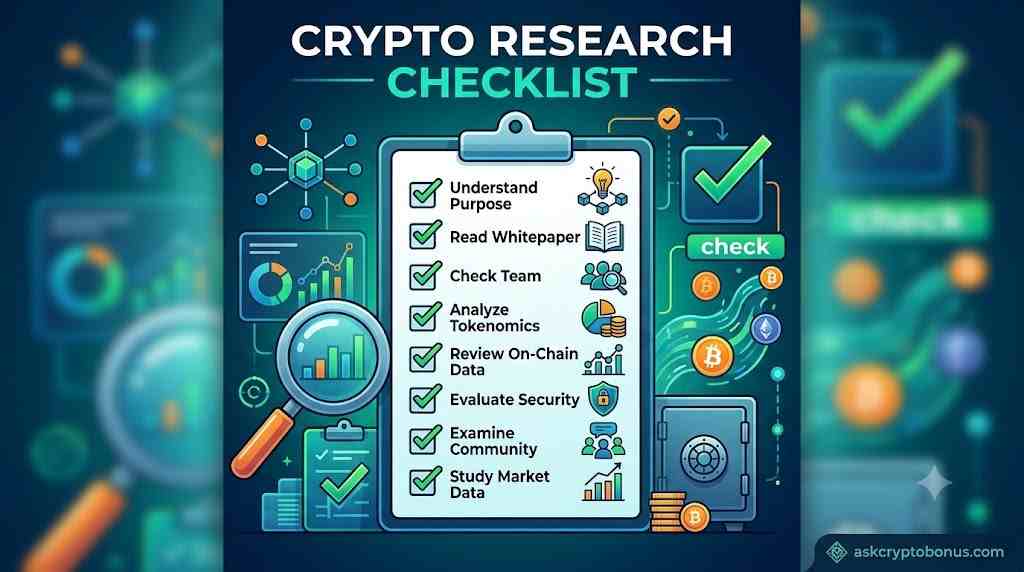
Use this simple checklist before deciding whether to explore a project further.
Crypto research checklist
0 of 8
The project has a clear purpose and use case
The whitepaper and documentation are credible
The team and important claims have been checked
Tokenomics and upcoming unlocks are understood
Blockchain activity has been independently reviewed
Security audits and contract permissions have been examined
Community activity and partnerships have been verified
Liquidity, market data, and major risks have been assessed
Reset checklist
Completing this checklist does not guarantee that a project is safe or profitable. It simply provides a structured way to identify gaps in your research.
Conclusion
Learning how to research a crypto project requires more than checking its price, popularity, or social media presence. You need to examine its purpose, documentation, team, tokenomics, blockchain activity, security, community, and market conditions.
Use independent sources to verify important claims, investigate potential red flags, and avoid making decisions based on hype or fear of missing out.
At askcryptobonus.com, we encourage readers to build their cryptocurrency knowledge before taking financial risks. Thorough research cannot eliminate uncertainty, but it can help you make more informed decisions.
Explore Crypto Projects with Confidence
Before exploring any cryptocurrency, take time to research its technology, development team, tokenomics, security, and potential risks. Understanding these factors can help you make more informed decisions and avoid projects that rely on misleading promises.
At askcryptobonus.com, we provide educational resources to help you understand cryptocurrency, blockchain technology, crypto security, and digital assets.
Ready to learn more? Explore our crypto guides and discover practical tips to help you evaluate cryptocurrency projects more carefully.
Learn How to Research a Crypto Project
Affiliate Disclosure
This article may contain affiliate links. If you click an affiliate link and complete a qualifying action, askcryptobonus.com may earn a commission at no additional cost to you. Affiliate relationships do not guarantee the quality, security, or performance of any cryptocurrency project. Always conduct your own research, verify information independently, and understand the risks before making financial decisions.
Disclaimer: This content is for educational and informational purposes only and should not be considered financial or investment advice. Cryptocurrency investments involve significant risk, including the potential loss of your entire investment.
Frequently Asked Questions (FAQ)
- How to research a crypto project as a beginner?
Start with the official website and whitepaper. Understand the project’s purpose, verify its team and partnerships, examine tokenomics, and check security information. Use independent sources to confirm important claims.
- Which website is best for researching cryptocurrency projects?
There is no single best website for every type of research. Official documentation, blockchain explorers, market-data platforms, and independent security reports provide different types of evidence. Compare multiple sources.
- How can I tell if a crypto project is legitimate?
Check whether its claims are verifiable, its tokenomics are transparent, its technology has credible documentation, and its security risks are acknowledged. No individual check can guarantee legitimacy.
- Why is tokenomics important when researching crypto?
Tokenomics explains how tokens are distributed, used, and introduced into circulation. It can reveal potential risks involving concentrated ownership, inflation, and large future token unlocks.
- Does a crypto audit guarantee that a project is safe?
No. An audit evaluates specific code and conditions at a particular time. It cannot guarantee that all vulnerabilities have been discovered or that the project will remain secure.
- How long does it take to research a crypto project?
A basic review may take a few hours, while a detailed technical and financial assessment can take days or longer. The time required depends on the project’s complexity and the quality of available information.
- Can I rely on social media when researching crypto?
Social media can help you discover announcements and community discussions, but it should not be your only source. Verify claims through official documentation, independent sources, and on-chain data.