Sintu Kumar
How Does Bitcoin Work Step by Step? A Beginner’s Guide
Bitcoin is one of the most popular cryptocurrencies in the world. It allows people to send and receive digital money over the internet without relying on a traditional bank to process every transaction. However, many beginners still wonder: how does bitcoin work step by step?
Understanding Bitcoin becomes easier when you learn about blockchain technology, digital wallets, public and private keys, Bitcoin transactions, and mining. In this guide from askcryptobonus.com, we explain how Bitcoin works in simple language.
What Is Bitcoin?
Bitcoin is a decentralized digital currency introduced in 2009 under the name Satoshi Nakamoto. Unlike traditional currencies, Bitcoin is not controlled by a central bank or government.
Instead, Bitcoin operates through a distributed computer network that follows shared rules. Transactions are recorded on a public blockchain, which allows network participants to verify activity.
Bitcoin can be transferred between digital wallets, and its supply is limited by its protocol to 21 million coins. However, its market price can change significantly, so understanding the technology does not eliminate investment risk.
How Does Bitcoin Work Step by Step?
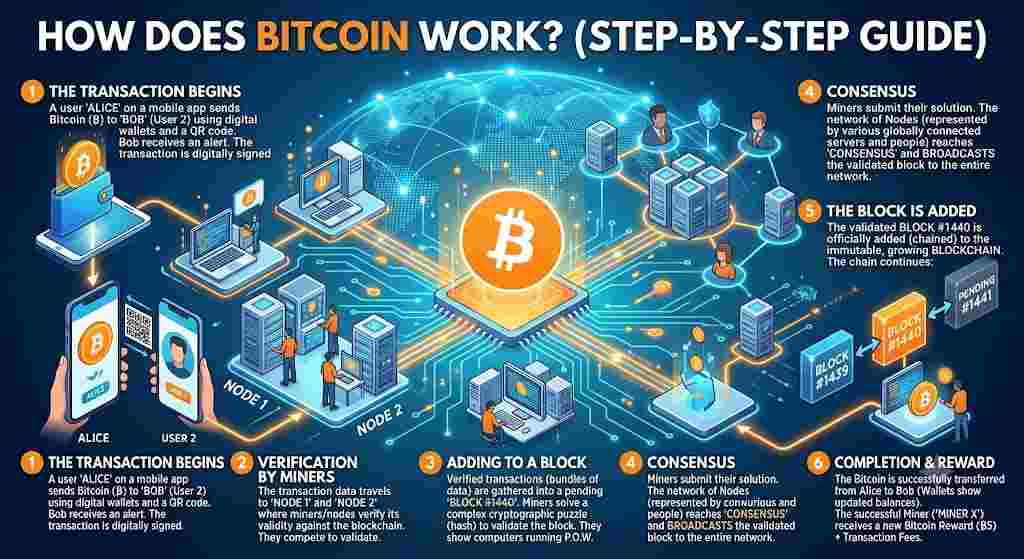
To understand how does bitcoin work step by step, let’s explore the main stages of a typical Bitcoin transaction.
Step 1: Create a Bitcoin Wallet
The first step is to create a Bitcoin wallet. A wallet helps you manage your Bitcoin addresses and the cryptographic keys needed to authorize transactions.
Different wallet options include mobile wallets, desktop wallets, hardware wallets, and web-based wallets.
A Bitcoin wallet does not literally store coins like a physical purse. Instead, it helps you access and manage Bitcoin recorded on the blockchain.
Always protect your recovery phrase and private keys. Anyone who obtains the necessary credentials may be able to control your funds.
Step 2: Receive Bitcoin
To receive Bitcoin, you share your Bitcoin address with the sender. This address works somewhat like an account destination.
The sender uses your address to create a transaction that transfers Bitcoin to an output you can spend.
Before receiving funds, verify that the sender uses the correct address and the Bitcoin network. Sending cryptocurrency to an incompatible address or network may result in permanent loss.
Step 3: Create a Bitcoin Transaction
When someone wants to send Bitcoin, their wallet creates a transaction.
The transaction identifies the Bitcoin being spent and specifies where the funds should go. The wallet uses the sender’s private key to produce a digital signature that authorizes the transaction.
This signature helps the network verify that the transaction was authorized by someone who controls the relevant funds.
The private key itself should never be shared with the recipient or entered into an untrusted website.
Step 4: Broadcast the Transaction
After signing, the wallet broadcasts the transaction to the Bitcoin peer-to-peer network.
Computers running Bitcoin software, commonly called nodes, receive and check transactions against the network’s rules.
These checks include whether the inputs are valid, whether the transaction is properly authorized, and whether the same Bitcoin is already being spent elsewhere.
A valid transaction may then be relayed to other nodes and wait in a collection of unconfirmed transactions known as the mempool.
Step 5: Bitcoin Miners Select Transactions
Bitcoin uses a consensus system called Proof of Work.
Miners collect eligible transactions into candidate blocks. They then compete to find a block header hash that satisfies the network’s current difficulty target.
This process requires substantial computing work. Mining is not simply guessing a password; it involves repeatedly hashing candidate block data while following Bitcoin’s consensus rules.
Miners typically prioritize transactions based partly on the fees offered relative to transaction size.
Step 6: A New Block Is Added to the Blockchain
When a miner finds a valid block, it broadcasts the block to the network.
Nodes independently check the block and its transactions. If the block follows the consensus rules, nodes can accept it and build on it.
Each block references the previous block through a cryptographic hash, linking blocks into a chain. This structure helps make historical changes detectable and makes rewriting confirmed history increasingly difficult.
The blockchain is maintained by a distributed network rather than one central organization.
Step 7: The Recipient Gets Confirmation
When a transaction appears in an accepted block, it receives its first confirmation.
As additional blocks are added, the transaction gains more confirmations. More confirmations generally increase confidence that the transaction will remain part of the accepted blockchain history.
The time needed for confirmation varies. Bitcoin targets an average block interval of about ten minutes, but actual timing can be shorter or longer.
For large payments, recipients may wait for additional confirmations before treating the transaction as final for their purposes.
Step 8: The Transaction Is Completed
After the transaction is confirmed to the recipient’s satisfaction, the recipient can use the received Bitcoin in a future transaction.
This completes the basic process of how does bitcoin work step by step: a wallet creates a transaction, the network verifies it, miners include it in a block, and nodes validate the block.
Bitcoin does not require a conventional bank to approve each transfer, although exchanges and other services may apply their own rules when customers use them.
What Is Blockchain in Bitcoin?
A blockchain is a distributed record of transactions organized into blocks. Each block references the previous block, creating a chronological structure.
Bitcoin nodes independently validate transactions and blocks according to shared consensus rules. This arrangement makes it possible for participants around the world to maintain a consistent ledger without relying on a single central record keeper.
Although the blockchain is public, wallet addresses do not automatically reveal the real-world identity of their owners. However, transaction patterns and other information may sometimes link addresses to individuals.
Learn More About Bitcoin Today
Want to understand Bitcoin better? Explore our beginner-friendly guides to learn how Bitcoin works step by step, how crypto wallets work, and how blockchain transactions are verified.
Ready to explore cryptocurrency? Visit askcryptobonus.com for more Bitcoin guides, crypto tips, and educational resources.
CTA Button Text: Learn More About Bitcoin
Button Link: https://askcryptobonus.com/
What Are Bitcoin Mining and Transaction Fees?
Bitcoin mining secures the network through Proof of Work and helps determine which valid transactions are added to blocks.
Miners can receive newly issued Bitcoin through the block subsidy and collect transaction fees. The block subsidy decreases according to Bitcoin’s issuance schedule.
Transaction fees compensate miners for including transactions in blocks. Fees vary with network demand and the amount of block space a transaction requires.
Neither mining nor transaction fees guarantee that Bitcoin’s market value will increase.
Advantages and Risks of Bitcoin
Bitcoin offers several potential benefits:
- Decentralization: No single central bank controls the Bitcoin network.
- Global transfers: Bitcoin can be sent across borders where access and applicable laws permit.
- Transparency: Transactions are publicly verifiable on the blockchain.
- Limited supply: Bitcoin’s protocol sets a maximum supply of 21 million coins.
However, Bitcoin also carries risks:
- Price volatility: Its market price can rise or fall sharply.
- Security risks: Lost private keys or recovery phrases may mean losing access to funds.
- Irreversible transfers: Confirmed transactions generally cannot be reversed through a bank-style chargeback.
- Scams: Fake investment platforms and fraudulent giveaways can cause financial losses.
- Regulatory uncertainty: Laws and tax treatment vary by country and may change.
Learn the technology before deciding whether Bitcoin is appropriate for your circumstances.
Conclusion
Understanding how does bitcoin work step by step helps beginners see how digital payments can operate without a central transaction processor. Bitcoin wallets create and authorize transactions, nodes verify them, miners use Proof of Work to produce blocks, and the blockchain records accepted transactions.
For more beginner-friendly cryptocurrency education, visit askcryptobonus.com. Continue learning about Bitcoin wallets, blockchain security, and cryptocurrency risks before making financial decisions. Remember that Bitcoin is a volatile asset, and educational knowledge should